Bedding · Bed styling
A Pillow-Layering Blueprint: How Shams Shape a Refined Bed
A composed bed is less a pile of pillows than a small study in proportion. Shams can frame the sleeping pillows, draw the eye across the head of the bed, and introduce texture without sacrificing comfort. The secret is knowing what each layer is for—and when to stop.
At the end of the day, the bed is a working landscape. It has to welcome a sleeper, accommodate a changing temperature, and survive the ordinary choreography of waking, making, and turning down. Yet when the room is still, its broad planes of cloth become one of the largest visual surfaces in the home. A pillow arrangement can make that surface feel settled and inviting—or busy, top-heavy, and difficult to use.
Shams are among the simplest tools for creating order. They are pillow covers designed primarily for presentation, often finished with a border, flange, embroidery, quilting, or other detail. A pillowcase, by contrast, is generally intended to protect the pillow used for sleeping. The distinction is not absolute: some shams are comfortable enough for everyday use, and some pillowcases are finished with decorative stitching. But separating the roles helps make a bed both handsome and practical.
The aim is not to imitate a hotel or reproduce a single ideal arrangement. It is to build a sequence that suits the bed, the room, and the people who use it. Think of the layers as a quiet composition: a useful foundation, a clear frame, and perhaps one or two accents that add depth.
Begin with the bed, not the pillows
Before choosing a sham, look at the scale of the bed. A king-size mattress can carry a wider arrangement than a twin, while a low headboard may call for a shorter stack than a tall upholstered one. The room matters, too. In a compact bedroom, a deep row of decorative pillows may crowd the bed and make the floor feel even tighter. In a large room, a sparse arrangement can seem lost unless it has enough width or contrast to hold its place.
Take note of the mattress dimensions, headboard height, and the proportions of the duvet or coverlet. Then consider where the pillows will sit during the day and where they will go at night. If there is little storage nearby, a dozen accent pillows are not a neutral design choice; they are a nightly task. A refined arrangement is one that can be put away easily and restored without elaborate effort.
Scale is more than a matter of matching a label. Pillow dimensions and sham dimensions can vary by maker, and the fullness of the insert changes the final appearance. A generously filled sham tends to look plump and structured. A flatter insert gives it a softer profile. Before selecting decorative covers, check their stated dimensions and compare them with the insert you already own. If the cover is much larger, it may look slack; if it is too small, the corners can strain and the fabric may pull.
Build the layers in a useful order
A dependable arrangement starts with the pillows used for sleeping. These usually sit closest to the headboard, where they are easy to reach at night. They may be dressed in pillowcases that coordinate with the sheets, keeping the most practical layer simple and washable.
Shams can then create a backdrop. Depending on the bed and the number of sleepers, that might mean one pair of shams, a row of larger square shams, or no extra layer at all. Standard shams often sit naturally behind sleeping pillows on a smaller bed. Larger Euro-style squares can create a broader, more architectural foundation on a queen or king, though they are not compulsory. The right choice is the one that fills the bed’s width without overwhelming it.
Decorative pillows belong in front, where their shape, color, or finish can be seen. One lumbar cushion can introduce a horizontal line across a row of square pillows. A single smaller accent can provide a restrained focal point. More pieces can work, but each should have a reason: to repeat a color, vary a texture, soften a sharp edge, or connect the bed to another detail in the room.
This sequence—sleeping pillows, a supporting sham layer, then a limited accent—offers a useful blueprint rather than a rulebook. Some beds look best with just two sleeping pillows and matching shams. Others benefit from a deeper arrangement. The important thing is that each layer remains legible. When every pillow competes for attention, the bed loses its visual resting place.
Use shape to create rhythm
Shape gives a bed its visual rhythm. Repeating a pair of similarly sized pillows creates symmetry and calm, while introducing a long cushion or a smaller accent changes the cadence. A useful way to think about pillow layering is to move from broad forms at the back toward narrower ones at the front. The eye can then travel across the arrangement without having to navigate a jumble of shapes.
Symmetry is a reliable starting point because it echoes the bed’s central axis. Place equal pairs on either side and let the headboard or center of the mattress guide the arrangement. This is especially effective when the bedding itself has a strong pattern, contrast piping, or embroidered detail. The structure of the pillows gives the eye a stable frame for reading those features.
Asymmetry can feel more relaxed, but it benefits from balance. A larger pillow on one side might be countered by a pair of smaller forms on the other. A single patterned sham can be repeated elsewhere in the room through a throw, rug, or curtain detail. Balance does not require identical objects; it requires that the visual weight feels distributed rather than accidentally lopsided.
For a narrow bed, fewer shapes usually make the strongest impression. On a wider bed, a broad row can be broken up by a central accent. In either case, leave enough of the headboard visible to show its outline and material. A pillow arrangement that covers every edge may hide one of the room’s most defining pieces of furniture.
Let fabric tell the story
Texture is what keeps a restrained palette from feeling flat. Linen, cotton percale, cotton sateen, and lyocell each create a different surface impression. Linen tends to show the irregularities and soft creases associated with its relaxed character. Percale usually reads as crisp and matte. Sateen has a smoother, often subtly lustrous face. Lyocell can have a fluid drape and a cool, silky hand. These differences are visible even when the colors are closely related.
When using more than one fabric, think in terms of contrast rather than accumulation. A matte sham against smooth sheets may supply enough variation. A quilted layer can bring dimension to an otherwise simple bed. If the coverlet already has a pronounced pattern, a quieter sham can keep the whole arrangement from becoming visually loud.
Color works in much the same way. A tonal bed combines neighboring shades—ivory with warm white, or pale flax with a deeper natural hue—to create depth without sharp contrast. A more dramatic scheme might pair pale bedding with a dark headboard or a strong accent color. Either approach can feel polished. The key is to repeat important colors deliberately so they seem connected to the room rather than newly introduced for the bed alone.
Consider the light in the bedroom, too. A color that appears crisp in a bright morning may look warmer or more muted under a lamp. Texture shifts with light as well: a slight sheen catches highlights, while a matte weave tends to absorb them. Looking at fabric in the actual room, if possible, can prevent surprises and make the choices feel more grounded in the space.
Details work best when they have room
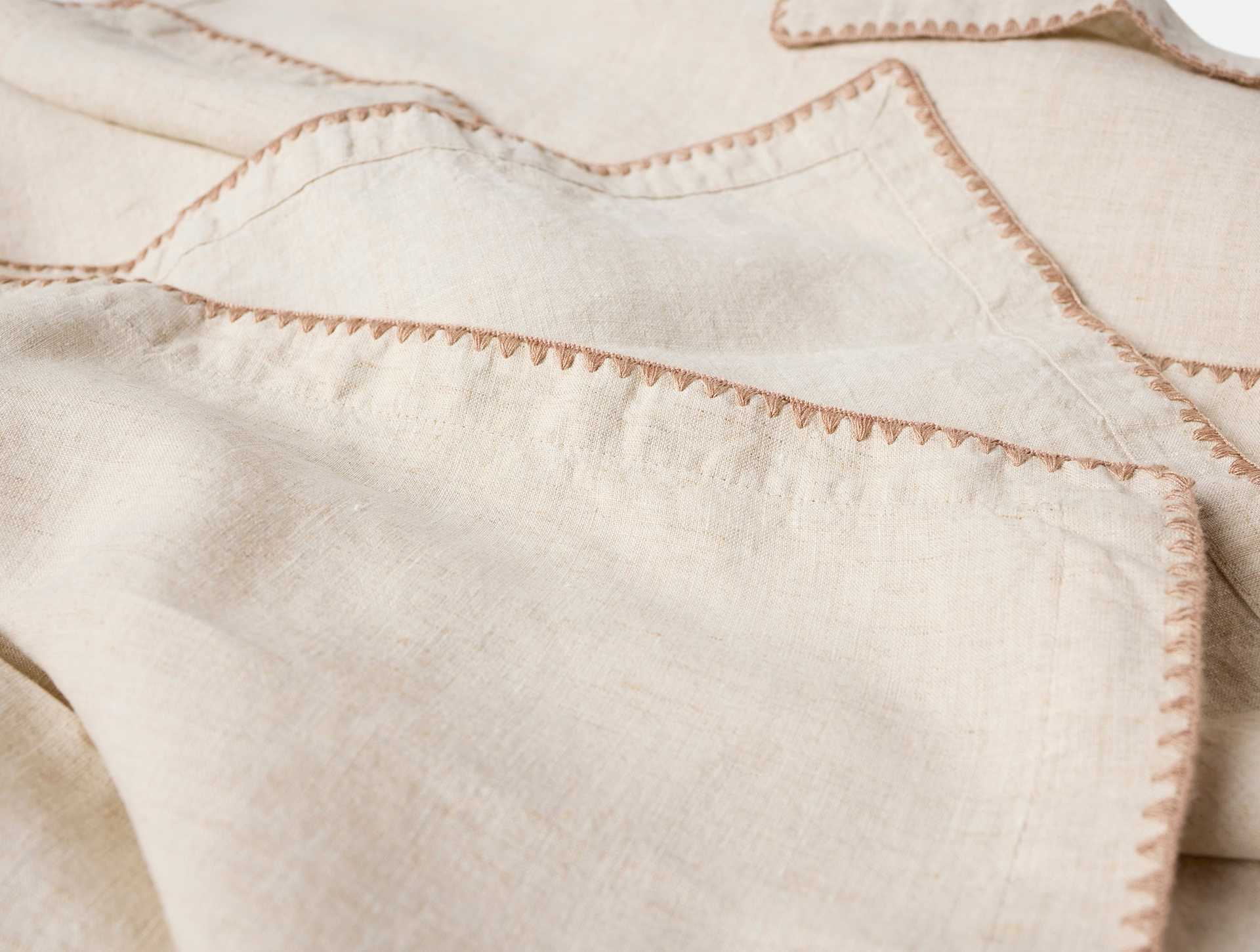
Embroidery, piping, lace, quilting, hemstitching, and flanges can all make a sham distinctive. They also establish a visual scale. A fine line of stitching may read as a quiet finish from across the room, while a wide flange or bold embroidered motif can become a focal point. Give such details space. When several strong finishes sit side by side, they can obscure one another instead of adding richness.
A sham with a decorative border can be positioned so the edge remains visible, rather than disappearing behind another pillow. On a layered bed, the front edge of a larger sham may be partly covered by the pillows in front; this can look intentional if the design still has room to register. Before settling on the arrangement, step back from the bed. Details that are obvious at arm’s length may vanish—or become too dominant—across the room.
For a calm, tailored effect, repeat one finish rather than collecting many. A line of embroidery on the pillowcases might echo the edge of a sham. A quilted sham could be the bed’s single dimensional accent, set against plain sheets and a simple duvet. A useful measure is whether the detail supports the overall composition. If removing one decorative layer makes the bed feel clearer, the extra layer may not be doing necessary work.
A few material-led examples
A linen-forward bed can draw on the fabric’s visible weave and relaxed drape. A washed linen sham, such as the Tahoe Stripe Pillow Sham, combines a stripe with a soft, breathable linen surface. It can bring pattern to a plain duvet or repeat the linear direction of a striped blanket. Keep other patterns quiet if the stripe is meant to lead.
For a smoother, more luminous impression, the BOVI Olivia Pillowcases and Shams use TENCEL™ Lyocell in a pearl color. The subtle sheen and fluid surface offer a different kind of contrast from textured linen. Paired with a matte coverlet or simple cotton sheets, that difference can create depth without relying on a strong print.
These examples suggest two possible directions, not a prescribed combination. A bed need not mix fabrics to feel layered; variation can come from shape, stitching, or the way a coverlet folds. Likewise, a fabric’s description cannot determine how it will feel in every room or to every sleeper. Personal preference, construction, and care instructions matter just as much as appearance.
Make the arrangement comfortable to live with
Bedroom decor has to answer to real routines. If decorative pillows are removed each evening, choose a manageable number and decide where they will rest overnight. A bench at the foot of the bed, a basket, or an empty chair can provide a landing place, but only if it is already part of the room’s practical layout. Otherwise, the pillows can quickly become obstacles.
Choose covers that can be cared for appropriately. Check the maker’s guidance for washing and drying, especially when fabrics have embroidery, trim, or special finishes. Different fibers and constructions may require different routines, so avoid assuming that every cover can be washed in the same load or at the same temperature. Removing covers promptly from the dryer and following specific care directions can help preserve their shape and finish.
Think about touch as well as appearance. Decorative shams may sit against the face or be used as a backrest while reading. If that is likely, select a surface you find comfortable and consider how it behaves in your climate. A silky finish, a crisp weave, and a textured linen surface offer distinct experiences. There is no universal best choice; the useful question is how the pillow will actually be used.
Finally, make the bed easy to reset. A good arrangement should not require precise architectural training every morning. If each pillow has a clear place and the number of pieces suits your routine, the finished look will be more durable than a complicated display that is difficult to maintain.
Common layering missteps
- Choosing covers before checking inserts: A mismatch in size can leave the sham sagging or overstretched. Confirm both measurements and consider the insert’s fullness.
- Adding pillows without a purpose: Repeated shapes and decorative details can make the bed look crowded. Give every layer a role, whether it is support, texture, color, or a finishing edge.
- Ignoring bed proportions: A small collection can disappear on a wide mattress, while a large stack can overpower a narrow one. Use the mattress and headboard as guides.
- Mixing too many focal details: Multiple bold prints, trims, and contrasting colors may compete. Choose one lead feature, then let supporting pieces remain quieter.
- Prioritizing display over sleep: The sleeping pillows should remain easy to reach, and decorative layers should be easy to move. A beautiful bed still needs to work at bedtime.
A simple method for a finished bed
Start with the bedding you use every night. Put the sleeping pillows in place and choose pillowcases that suit the sheets. Add a pair of shams, or a row of larger shams, according to the width of the bed and the height of the headboard. Look at the arrangement from the doorway. If it already feels complete, stop there.
If the bed needs a little more definition, introduce one contrasting element: a different weave, a narrow stripe, a quilted surface, or a single smaller cushion. Keep the colors connected to the rest of the bedroom, and check that the front layer does not hide the sham details you wanted to show. Then remove one item and compare. The simpler version may be the more refined one.
This small editing process is often more useful than adding another decorative object. Pillow layering is an exercise in proportion and restraint, not a contest in quantity. Shams shape the bed by giving it an edge, a rhythm, and a texture. When their scale fits the mattress and their finish complements the other linens, they can make the whole room feel more composed.
In the end, a well-layered bed should invite both a glance and a night’s rest. Its arrangement can carry the quiet polish of a considered room while remaining easy to undo. Begin with comfort, give each layer a clear purpose, and let the materials do some of the talking. That is the blueprint: not more pillows, but better relationships between them.